
10 September, 2026

Hi Teacher Luke here!
Speaking confidently on the Duolingo English Test starts with knowing what each question asks you to do. You need to describe a photo, answer written prompts and respond to spoken follow-up questions.
In this guide, I’ll explain all four speaking question types and share practical strategies from my DET Ready lessons. You’ll also find practice questions to help you put those strategies into action.
Your goal is to communicate clear, relevant ideas with enough detail. You do not need an impressive life story or a memorised speech.
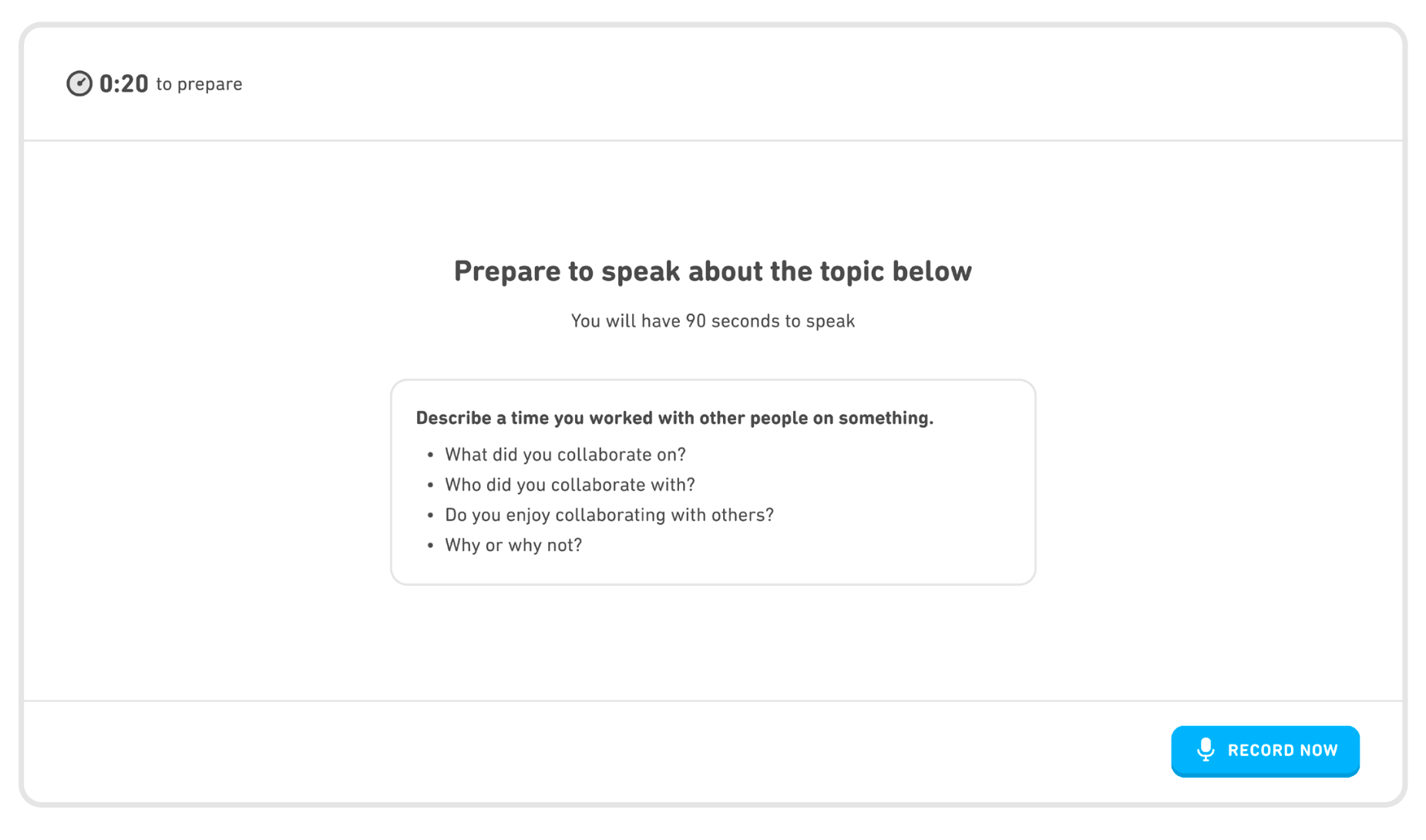
Read the written prompt and give a developed spoken answer. Use the supporting questions to organise your response and cover each part. The prompt remains visible while you speak.
Use your preparation time to choose your main idea and one useful example. Plan mentally, then follow the prompt’s bullet points.
My PPF method — Present, Past, Future — can help you develop relevant ideas. Explain your current situation, share a past experience and discuss a future possibility. Use the time frames that fit the question; you do not need to force all three into every answer.
For example, a question about a hobby could lead naturally from what you enjoy now to how you started and what you hope to learn next.
Watch my Speaking strategy video here 👇
For each prompt, prepare for 20 seconds, then speak for up to 90 seconds. Address the supporting questions.
1. Talk about a time when you had to adapt to a big change in your life.
- How did this change come about, and how did you feel when it first happened?
- What did you do to adjust to the new situation?
- How has this experience shaped the way you handle change today?
2. Describe a person in your life who has had a positive influence on your values or the way you think.
- Who is this person, and what is your relationship with them?
- What did they do or say that had such a strong influence on you?
- How are you different today because of this person?
3. Many people believe that spending time in nature is important for mental health.
- How can spending time in nature benefit a person's mental wellbeing?
- Do you personally make time to spend in nature? Why or why not?
- What could be done to make nature more accessible in people's daily lives?
4. Talk about a time when you helped someone through a difficult period in their life.
- What was the situation, and how did you become involved?
- What did you do to help, and how did it affect you personally?
- What did this experience teach you about the importance of being there for others?
5. Describe a hobby or activity that you feel passionate about.
- How did you first discover or develop this interest?
- How does it fit into your current routine?
- In what ways has this hobby had a positive impact on your life?
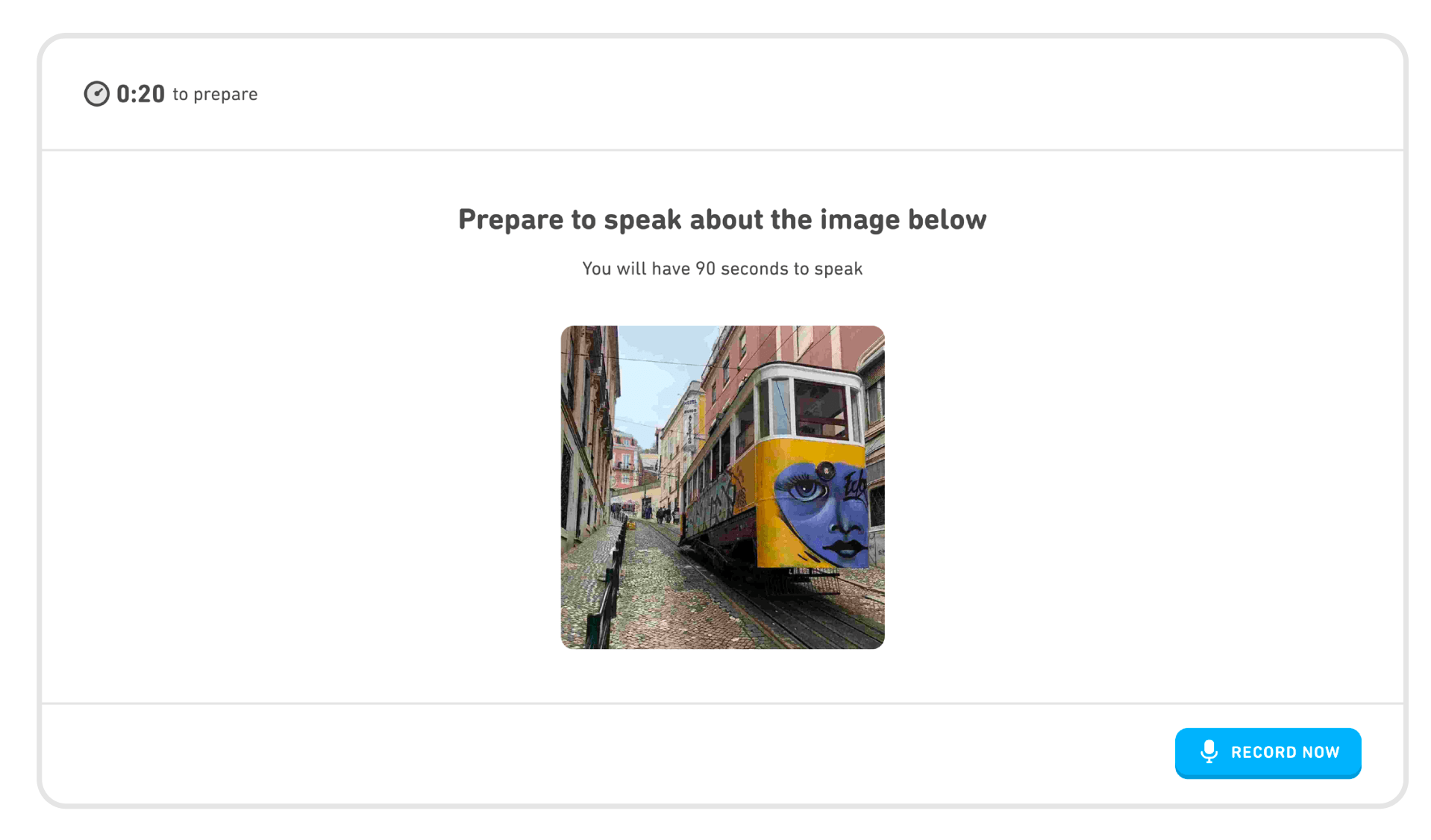
Describe the photo clearly enough for someone who cannot see it to imagine the scene. Start with the main subject, then add relevant details. You can keep looking at the image throughout your answer.
Use my five-step photo strategy, this makes speaking about a photo for 90 seconds much easier!
Keep guesses connected to visible evidence. If you cannot remember an exact word, explain it simply and continue. Move from one part of the image to another to avoid repeating yourself.
Watch my Speak About the Photo lesson here 👇
Look at each photo for 20 seconds, then describe it for up to 90 seconds using the five-step strategy.



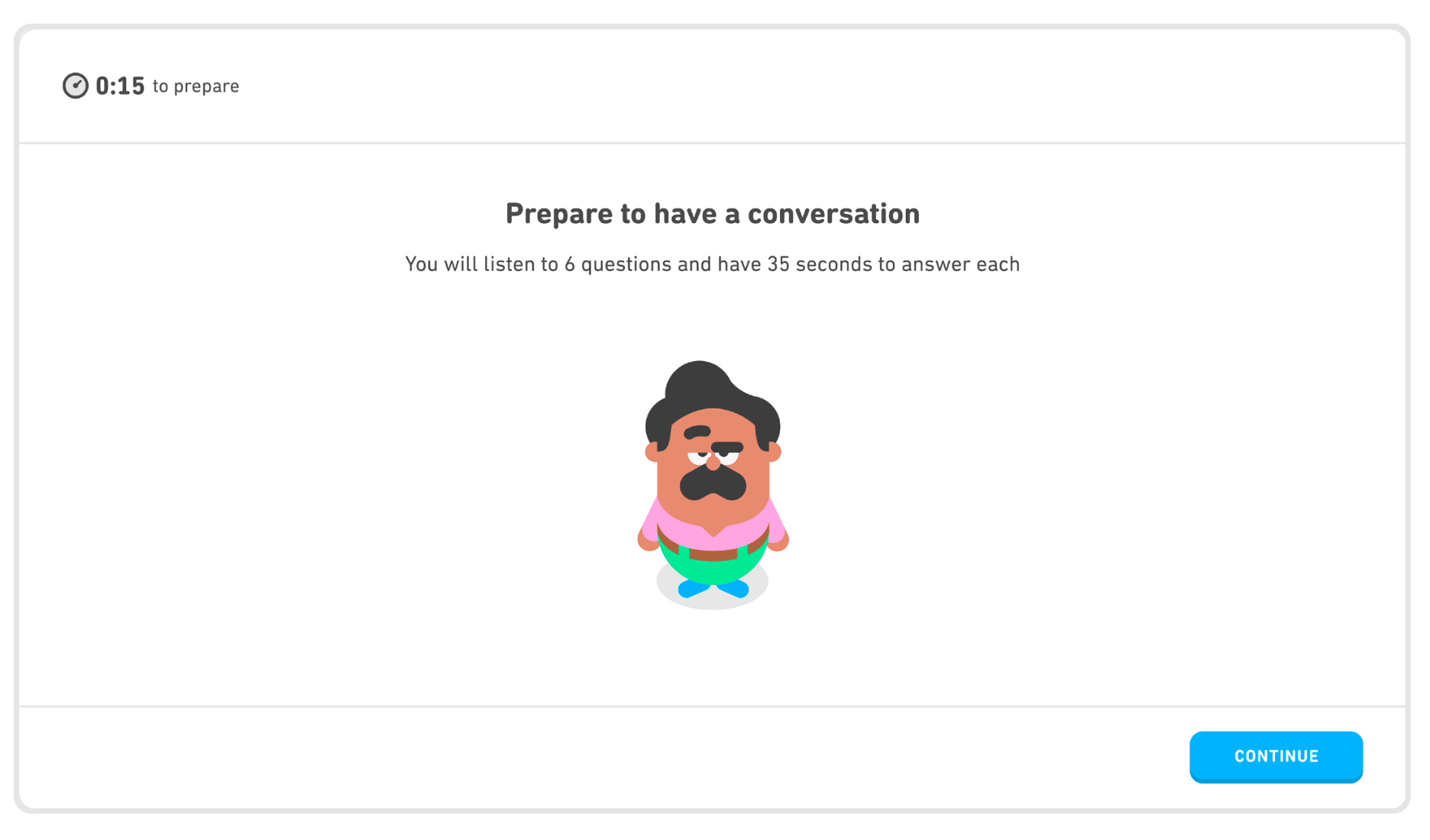
Listen to a Duolingo character and answer a series of 6–8 spoken questions. Follow-up questions can build on your previous answers. There is no separate preparation time, so practise responding promptly.
Answer directly in your first sentence. Then develop your answer using OREO framework:
Opinion: Give your answer or viewpoint.
Reason: Explain why.
Example: Add a specific detail or experience.
Outcome: Finish with a result or short conclusion, if time allows.
Treat this as a flexible guide. A question about an experience may need a short story instead. Listen carefully to each follow-up so your next answer responds to what was actually asked.
Practise with someone reading questions aloud, one at a time. Begin answering immediately and use a natural conversational pace.
Watch my Interactive Speaking lesson 👇
These are short topic drills, rather than a complete test conversation. Have a partner read each question once, then answer immediately for up to 35 seconds. For more realistic practice, ask your partner to adapt the follow-ups to your answers.
Topic: Learning
Topic: Food and daily habits
Topic: Technology
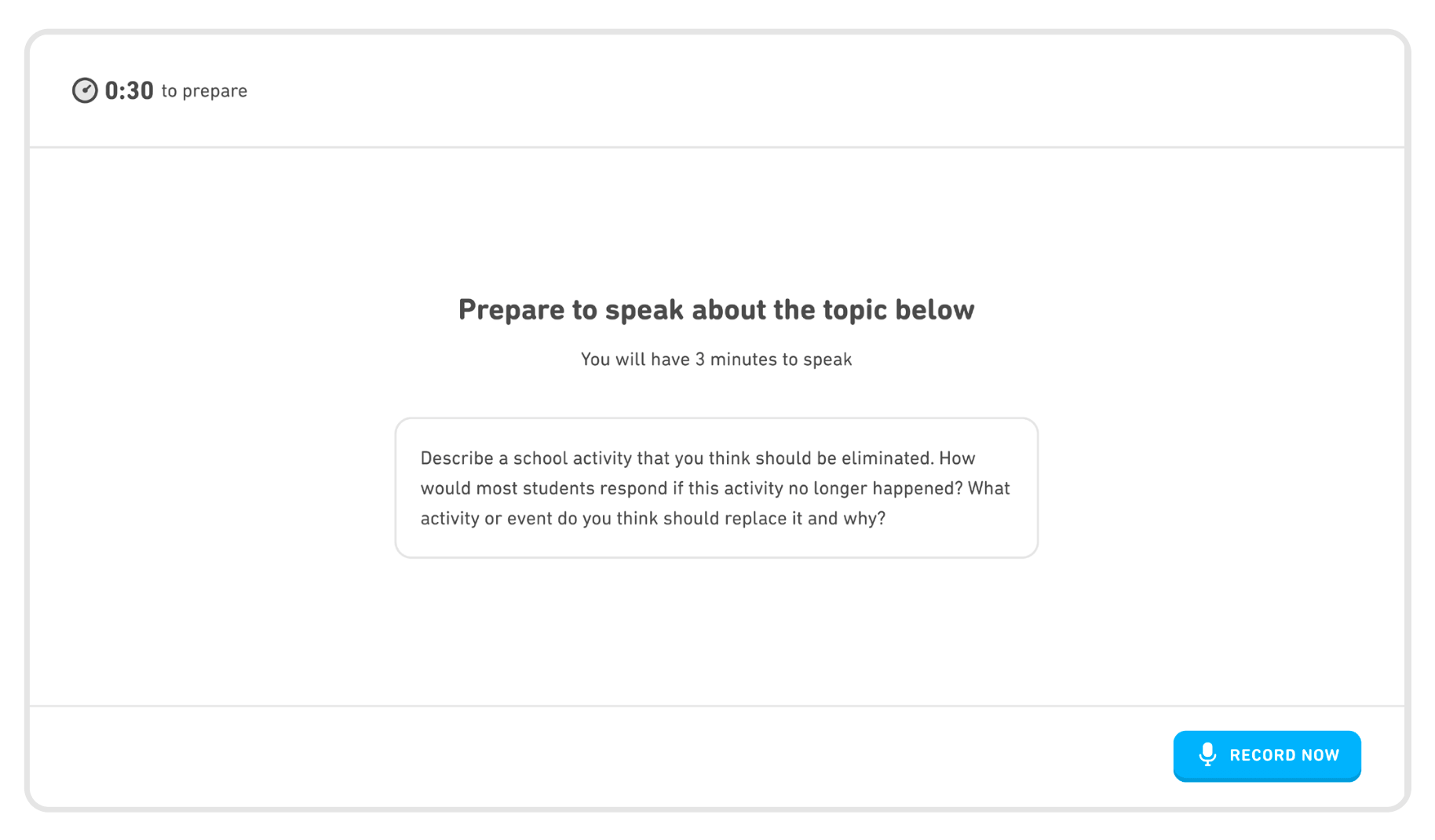
Read a prompt and give a longer spoken response. The Speaking Sample contributes to your overall DET score and its video recording is available to institutions receiving your results.
Use your 30 seconds of preparation to decide your main answer and two supporting ideas. Begin clearly, develop each idea with reasons and examples, and finish with a brief reflection.
PPF can help you expand your response when relevant. A personal experience is especially useful because you can explain what happened, why it mattered and what you learned.
Practise sustaining a thoughtful answer for up to three minutes. Avoid repeating the same point just to fill time.
Prepare for 30 seconds, then record a response of up to three minutes. Develop your ideas with reasons and examples.
1. Many people argue that spending time with family is more important than career success. To what extent do you agree? How do you personally balance the demands of work or study with time for the people you care about? Give reasons and examples to support your ideas.
2. Describe a time when you had to step outside your comfort zone to achieve something important. What was the situation, how did you handle it, and what did you learn from the experience?
3. Do you think individuals have a personal responsibility to help protect the environment, or is it mainly the job of governments and large companies? Give reasons and examples to support your ideas.
4. Do you think the way people work has changed for the better over the last twenty years? How has technology changed the workplace, and what do you think work will look like in the future? Give reasons and examples to support your ideas.
5. Some people believe that traveling to other countries is one of the best ways to learn about the world. To what extent do you agree? Has travel ever changed the way you think about something? Give reasons and examples to support your ideas.
6. How important is it for young people to learn about managing money? Should financial education be taught in schools? Give reasons and examples from your own experience or observations to support your ideas.
7. Think about a goal you set for yourself and worked hard to achieve. What was the goal, what challenges did you face along the way, and what kept you motivated? What did the experience teach you about yourself?
8. Do you think social media has made it easier or harder for people to form genuine friendships? How has the rise of social media changed the way people connect with others? Give reasons and examples to support your ideas.
9. Some people believe that success in life depends mostly on hard work, while others think luck and circumstances play a bigger role. Which view do you agree with more? Give reasons and examples from your own life or the lives of people you know.
10. Describe the community where you live or grew up. What do you value most about it, and what would you change if you could? How does where you grow up shape the kind of person you become?
Choose one task, record your answer and listen back. Did you answer fully? Were your ideas easy to follow? Which grammar or pronunciation mistake could you correct?
Try the question again with one clear improvement, then move to a fresh prompt. Regular practice with unfamiliar questions helps you become more comfortable organising ideas under time pressure.
For more guided preparation, join my DET Ready VIP Program!
Keep practising, and focus on making each answer clearer and more developed.
.png)
✅ Join my VIP Score-Boosting Program — I’ll teach you everything you need to know:
https://vip.detready.com
See you there,— Teacher Luke 👨🏫Helping 1,000+ students pass the DET every month
DET Ready are the leaders in English proficiency test preparation. Our mission is to streamline the learning process by helping students study smarter, not harder. We achieve this by carefully curating exactly what’s required to obtain the results and by discarding the
rest.
hello@detready.com